Salesforce consultant for Seattle, WA companies
We are a listed AppExchange Consulting Partner based in Malvern, Pennsylvania. We deliver Salesforce work for Seattle companies remotely — migrations, integrations, ongoing administration, Marketing Cloud and staff augmentation — and come in person when a meeting needs it.
Business and Salesforce data for Seattle
Every figure links to its public source. Metro-area figures unless stated.
- 110,685 business establishments in the Seattle metro
- 107,883 in 2018
- US Census Bureau, County Business Patterns 2023
- 323 establishments with 500 or more employees
- 266 in 2018
- Census CBP 2023 (sum of two published size classes)
- 2,360 establishments with 100–499 employees
- Census CBP 2023 (sum of two published size classes)
- 167,804 employees in professional, scientific and technical services
- 14,812 establishments
- Census CBP 2023
- 92,770 software developers employed in the metro
- median wage $167,280
- BLS Occupational Employment and Wage Statistics, May 2025
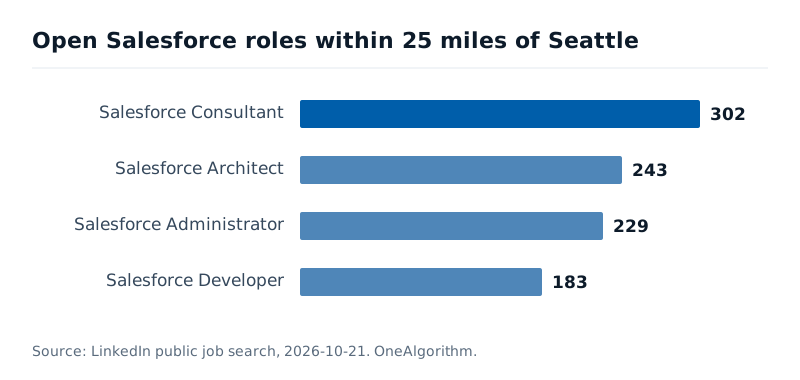
- 957 open Salesforce roles within 25 miles of Seattle
- Administrator 229 · Developer 183 · Consultant 302 · Architect 243
- LinkedIn job search: sum of four role-title searches, 2026-10-21 (each count links to its own search; this link is the consultant search)
Reading the Seattle data
On 2026-10-21, a LinkedIn search within 25 miles of Seattle returned 302 openings for Salesforce consultants, 229 for administrators, 243 for architects and 183 for developers — 957 in all, 9th of the 20 metro areas we checked.
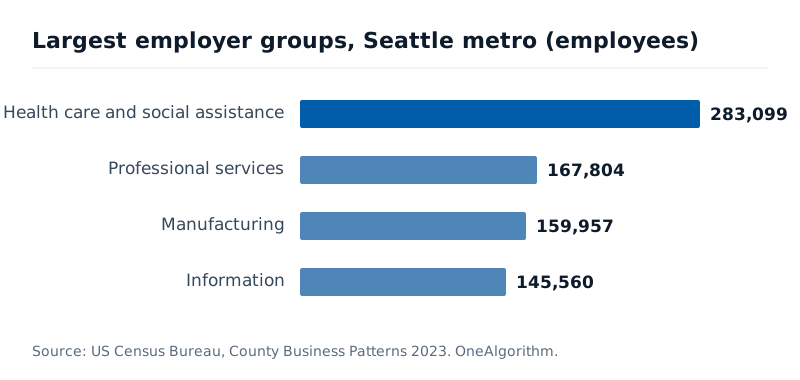
The metro had 110,685 business establishments in 2023, up 2.6% from 107,883 in 2018. Establishments with 500 or more employees went from 266 to 323 (+21.4%), while population changed +4.2% between 2019 and 2024. The largest employer group in our pull is health care and social assistance, with 283,099 employees across 13,557 establishments. Next come professional, scientific and technical services (167,804 employees) and manufacturing (159,957), then information (145,560). Those are the groups whose Salesforce needs we plan around when we scope work for a Seattle company.
Where Salesforce fits Seattle's largest industries
Employer groups ranked by employees, Census County Business Patterns 2023.
- Health care and social assistance. In the Seattle metro, 283,099 people work in health care and social assistance across 13,557 establishments; Salesforce work there usually turns on access — who can see which records — enforced with permission sets and sharing rules rather than a pile of profiles.
- Professional, scientific and technical services. In the Seattle metro, 167,804 people work in professional, scientific and technical services across 14,812 establishments; firms like these tend to use Salesforce to track clients, projects and proposals, and need reporting that agrees across all three.
- Manufacturing. In the Seattle metro, 159,957 people work in manufacturing across 3,154 establishments; manufacturers usually need Salesforce to agree with an ERP on accounts, orders and pricing, and we have built an SAP-to-Salesforce sync.
A technical market that builds on Salesforce
Seattle has a Salesforce office in Fremont and another in Bellevue, two Trailblazer Community Groups, and one of the largest software developer workforces of the metros we checked.
Teams with strong engineers often build integrations themselves and bring in a Salesforce specialist for the platform side: limits, Flow versus code, and how the data model will hold up as volume grows.
Seattle's open Salesforce roles in our LinkedIn search included more architect positions than developer ones, a sign that local teams are designing larger Salesforce estates and need platform-level judgment.
What Seattle callers ask first
Our engineers can build the integration. What would a Salesforce partner add?
Platform knowledge they may not have yet: governor limits, which API to use for which volume, when Flow is the right tool and when code is, and how to keep the org maintainable. We often pair with an internal team rather than replacing it.
Should we use Flow or Apex?
Flow for most business automation, because admins can maintain it. Apex where volume, complexity or performance need it. We decide case by case and write down why, so the next person understands the choice.
Can you review our Salesforce architecture?
Yes. Our free one-week org review covers the data model, automation, access and integrations, and ends with a ranked written list of what to fix first. Many of our people hold Salesforce Platform certifications.
How much demand is there for Salesforce skills in Seattle?
On 2026-10-21, a LinkedIn search within 25 miles of Seattle showed 957 open Salesforce roles: 302 consultant, 229 administrator, 243 architect and 183 developer openings. That ranked Seattle 9th of the 20 metro areas we checked. When that many employers compete for the same people, a partner can cover a defined project without a new hire.
Is there a Salesforce user community in Seattle?
Yes. 2 Salesforce Trailblazer Community Groups list the Seattle area: Salesforce Admin Group, Salesforce Women in Tech Group. Salesforce also lists an office at 744 N. 34th Street, Seattle, WA 98103; also 929 108th Ave NE, Bellevue, WA 98004. Upcoming regional events include World Tour Essentials Seattle (2026-11-03).
What does Salesforce talent cost in Seattle?
Salesforce roles have no job code of their own in federal wage data, so the closest official figure is software developers: in the Seattle metro, 92,770 are employed at a median annual wage of $167,280 (BLS, May 2025). For a migration, an integration or an org clean-up, a partner engagement is scoped and priced up front instead; our implementation cost guide shows published market ranges.
Salesforce consulting in other cities
Tell us what your Salesforce is doing wrong
An org nobody trusts, a migration that stalled, or an integration that fails quietly. Describe it and we will tell you what we would look at first.