Build it, price it, send it: what a product configurator is actually for
We built a 3D product configurator that prices eight custom arcade cabinets from $1,999 to $14,999. The 3D is the part people notice. The build sheet is the part that earns money. Including the performance work we have not finished.
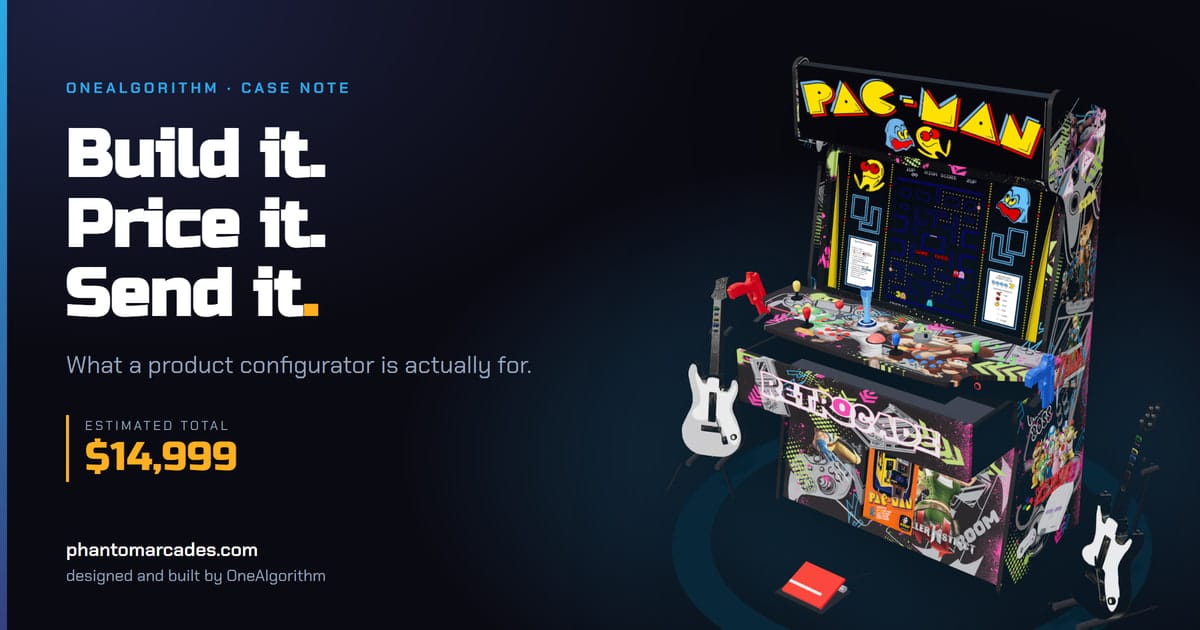
Short version: a 3D product configurator is not a toy on a product page. Its job is to turn a browsing session into a written specification the business can quote from. If it does not do that, it is an expensive spinning object.
The client
Phantom Arcades hand-builds custom arcade cabinets in Valrico, Florida. Dennis Riese builds them one at a time, to order. Nothing about that business fits a normal product page, because there is no product to put on it. There is a range of machines, and then there is whatever a customer asks for.
That is the actual design problem. Not "show the products". Let someone describe a machine that does not exist yet, and get a number back.
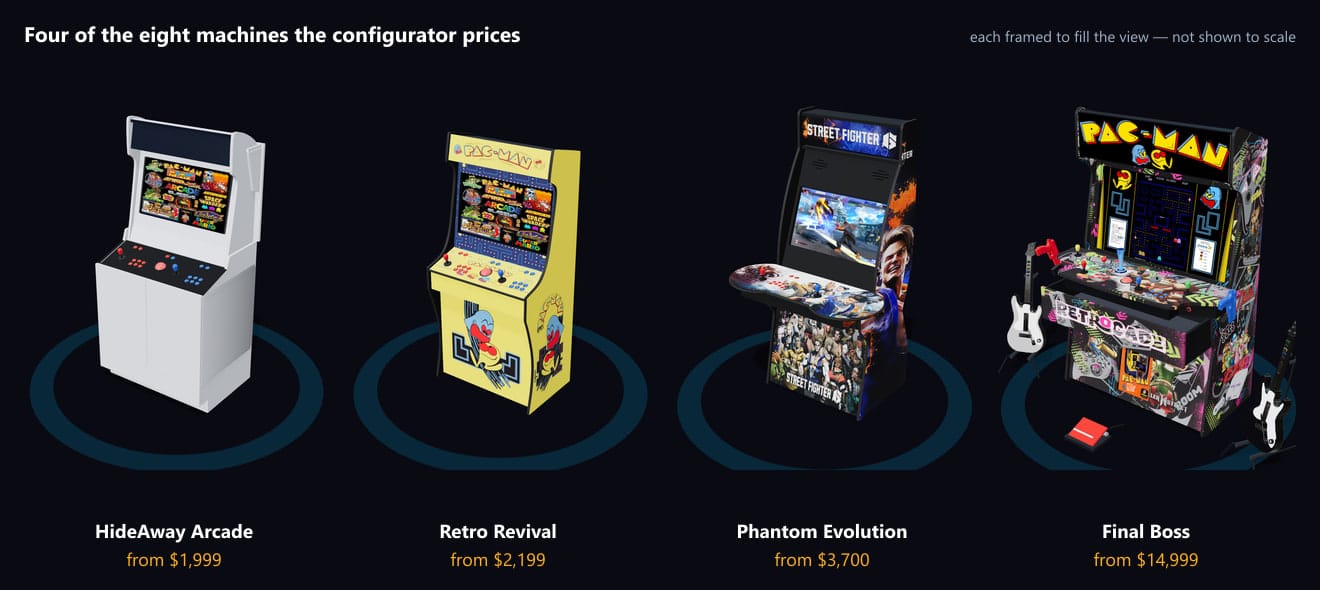
Eight cabinets, one interface, $1,999 to $14,999
The site configures eight machines. They are not variants of each other.
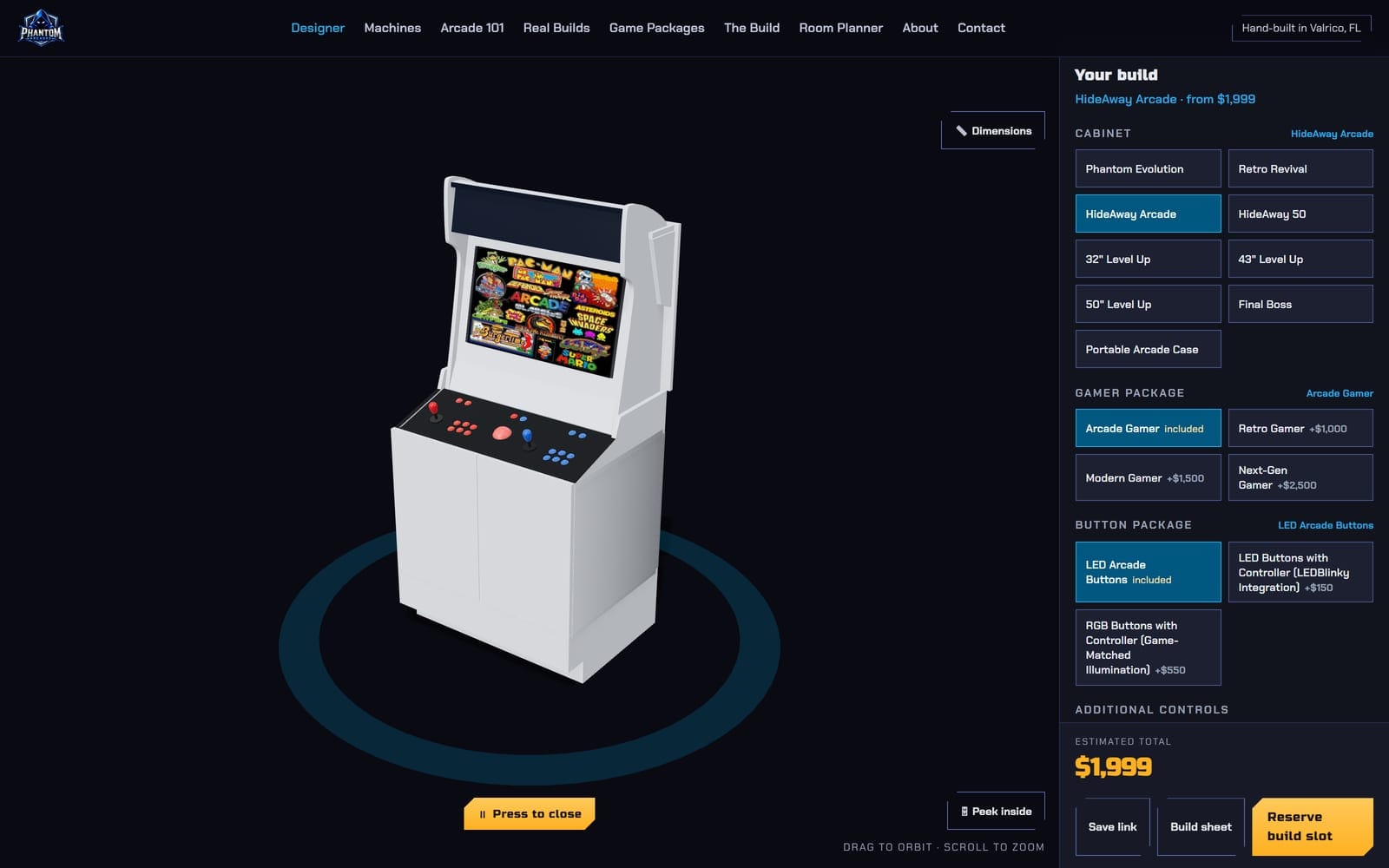
The HideAway Arcade is $1,999 and its whole point is disappearing. The hood closes over the controls and it stops looking like an arcade machine, which is how it gets into a living room instead of a basement. In the configurator it actually closes, because a still photograph cannot explain a thing that transforms.
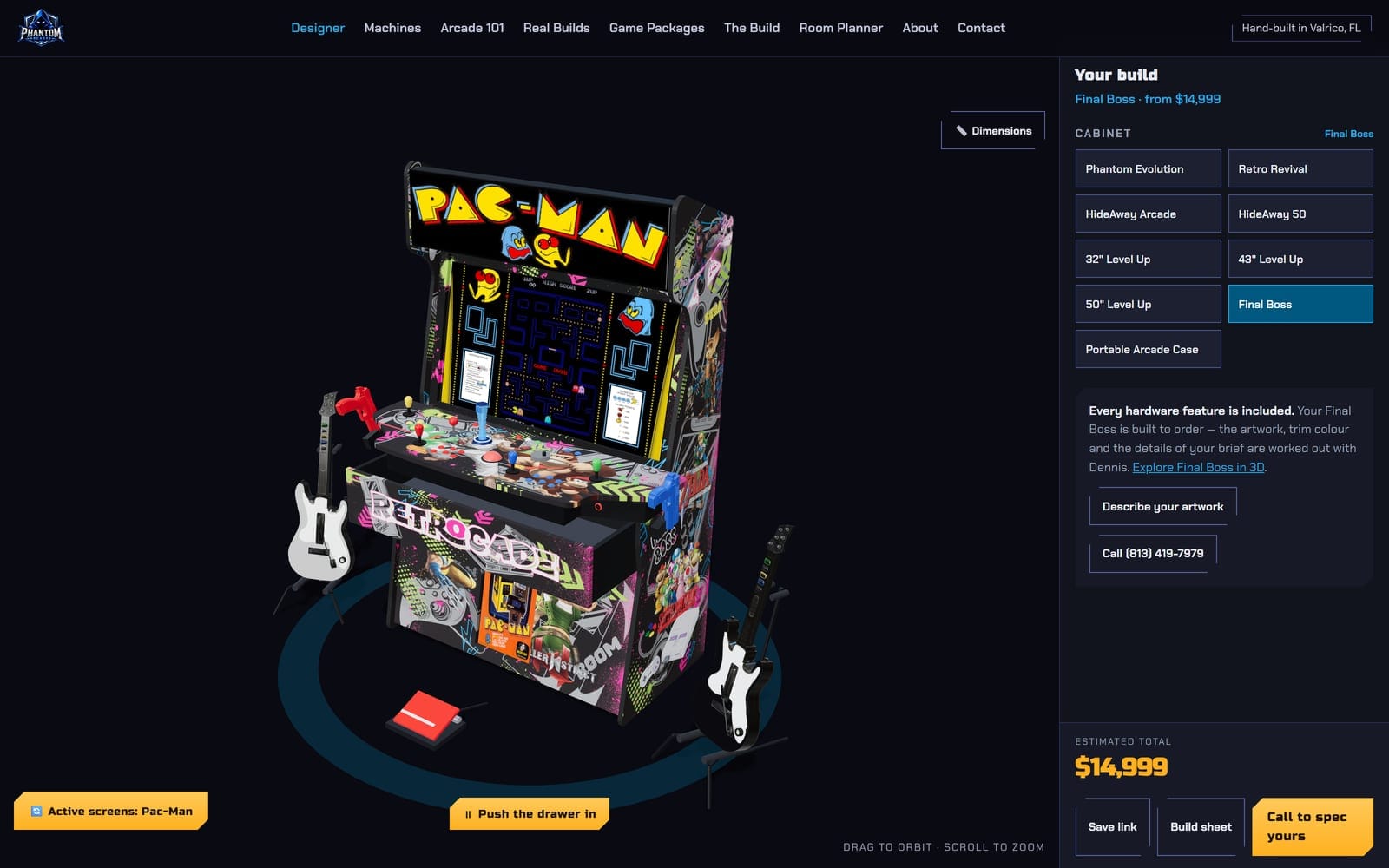
The Final Boss is $14,999 and is the opposite argument. Four players, 53 by 34 by 78 inches, three screens running at once, guitars and a drum pedal. It is furniture that dominates a room on purpose.
In between sit the Retro Revival at $2,199, three sizes of Level Up from $2,799 to $3,999, the Phantom Evolution at $3,700, and a portable case.
Here is the part worth stealing: the same three controls sit under every one of them. Save link. Build sheet. And then the enquiry, which is the only one that changes wording by machine — "Reserve build slot" on the ones with a list price, "Call to spec yours" on the Final Boss, which is a conversation rather than an order. A customer who has never seen an arcade cabinet does not have to learn a second interface to price the expensive one.
These are his machines, not our approximation of them
Every cabinet in that configurator except the portable case is loaded from Dennis's own SolidWorks export. Nine model files, prepped and optimised, but the geometry is his.
We started out drawing our own version of his product. It was wrong in the way approximations always are: near-enough silhouette, deck at the wrong height, buttons in roughly the right place. We threw it away. There is no reason to approximate a thing you have been given.
This is the least glamorous decision on the project and probably the most important one. A customer who has seen the real machine will recognise a fake, and the moment they do, every other number on the page becomes a claim rather than a fact.
The 3D is not the achievement
Rotating a cabinet is impressive for about eight seconds. Then it is wallpaper.
What the 3D actually buys you is that people change things. They try the four player deck. They price the next tier of internals. They see what $2,500 of upgrades looks like before deciding they do not want it. The model is a reason to keep touching the page, and touching the page is how someone arrives at a specification instead of a vague interest.
The mistake is to stop there. Most configurators do. You build the machine, you admire it, and the page offers you nothing but a contact form that has no idea what you just spent twenty minutes doing.
The three buttons that do the work

Save link. The whole build encodes into a URL. Send it to a partner, reopen it next week, paste it into an email to Dennis. Nothing is lost between the evening someone spent choosing and the morning they decide.
Build sheet. A plain text summary of exactly what was selected, with the price and the artwork notes. Not a PDF that needs a viewer. Something a person can paste into a message and a builder can read without opening the site.
The enquiry. It arrives already knowing the machine, the options and the number. Dennis is not starting from "hi, how much is an arcade machine".
That is the actual handoff, and it is the reason the configurator pays for itself. The 3D gets attention. The build sheet turns attention into something quotable.
Pricing in the open
The price moves as you choose: the machine, the internals, the button package, the sound, the controls. Custom artwork is a line item, not a conversation.
Showing the number is a commercial decision, not a technical one, and plenty of custom builders refuse to. The argument for showing it is that "call for pricing" filters out the people who would have bought and keeps the people who were never going to. A $14,999 machine should say $14,999 on the page. The people it scares off were not customers.
What is not finished
The configurator page is slow. It scores 34 out of 100 on a mobile performance test, and on a mid-range phone the browser is unresponsive for around seven seconds while it builds the 3D scene. Three.js and the model loading account for about six and a half of those seconds.
We know the fix, and we have not shipped it yet. The geometry is being assembled in the browser on every single visit when almost all of it could be baked once at build time and downloaded ready to draw.
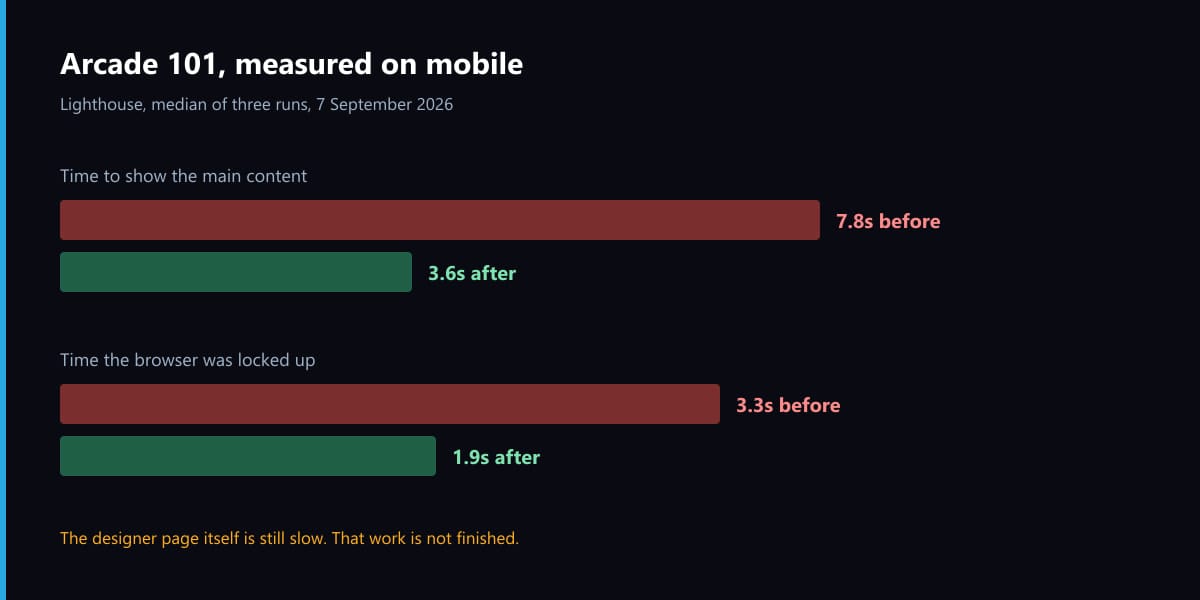
We did do this work elsewhere on the site, so the approach is proven rather than theoretical. The Arcade 101 page took 7.8 seconds to show its main content on a phone and locked the browser for 3.3 seconds. It now shows in about 3.6 seconds with 1.9 seconds of blocking, and no image or video on the page was degraded to get there.
Saying this out loud is deliberate. An agency case study that reports only wins is not describing a real project.
Four questions before you commission one of these
What does someone leave with? If the answer is "an impression", the 3D is decoration. They should leave with a link, a sheet, or an enquiry that already contains the build.
Is the geometry real? Ask whether it is the manufacturer's model or an artist's version of it. On a made-to-order product, the difference is credibility.
Does the price show? If it does not, be honest that the tool is a lead filter rather than a sales tool, and design it as one.
What does a search engine see? Ours currently sees an estimated total of $0, because the price is calculated in the browser and a crawler does not run it. That is on the list with the performance work.
What Dennis said
He left this on our Google listing after the site went live. His words, unedited.
Lou is an absolute pleasure to work with. From the moment we started working together till when my website went live, Lou has helped me every step of the way. I have never worked with someone so knowledgeable about what product they offer. I recommend OneAlgorithm but if you do reach out to them make sure you ask for Lou!
Posted on Google · Read it on our Google listing
He is also, obviously, not a neutral party — he paid for the work. Read it as a client saying the process was worth it, not as evidence that the site performs. The numbers earlier in this post are the evidence.
The point
The demanding part of this build was never the 3D. Three.js is well documented and the models were handed to us. The demanding part was deciding what a person walks away holding, and then making the page produce that thing.
Build it, price it, send it. If a configurator does not do the third one, it is a toy with a hosting bill.
OneAlgorithm designed and developed phantomarcades.com, including the eight-cabinet 3D configurator, the generated build archive and the room fit checker. We build and market websites for small businesses from Malvern, Pennsylvania.